
The World Trade Organisation is one of the world’s most significant intergovernmental organisations. Virtually every country in the world takes part and agrees to work within its framework.
It’s sometimes easy though to get confused as to what the precise role the WTO plays in international trade. Below we’ll look at who the WTO are, how they work and why they were created.

The new rules-based system after WW2
Out of the ashes of WW2 rose a new way of thinking in International Relations. To avoid conflict, countries agreed to in effect pool sovereignty and create new frameworks with supporting organisations that could create a rules-based international system. This system would then help to resolve any arising tension between countries without the need to resort to violence and conflict.
This system created intergovernmental organisations like the United Nations and established the precursor to today’s World Trade Organisation, the GATT or General Agreement on Tariffs and Trade.
GATT was an international treaty-based agreement signed in 1947 between 25 countries with the aim of achieving the:
“substantial reduction of tariffs and other trade barriers and the elimination of preferences, on a reciprocal and mutually advantageous basis“
Over the years the GATT countries reached many more agreements, this culminated in 1993 when meeting in Uruguay, 123 countries agreed to form the World Trade Organisation.
Ensuring that trade flows smoothly, predictably and freely...
As mentioned above, the World Trade Organisation formally came into existence in the early 1990s. It formally established that:
“The WTO shall provide the common institutional framework for the conduct of trade relations among its Members.”
The WTO is an organisation of its members, by its members and for its members. The staff work as a civil service rather than a police force or judiciary. Their over-riding aim is to ensure that trade disputes don’t tip into conflict.
The WTO state that they have 5 key roles:
- Improving people’s lives
- Negotiating trade rules
- Overseeing WTO agreements
- Maintaining open trade
- Settling disputes
The below video by the WTO sets out the purpose most clearly:

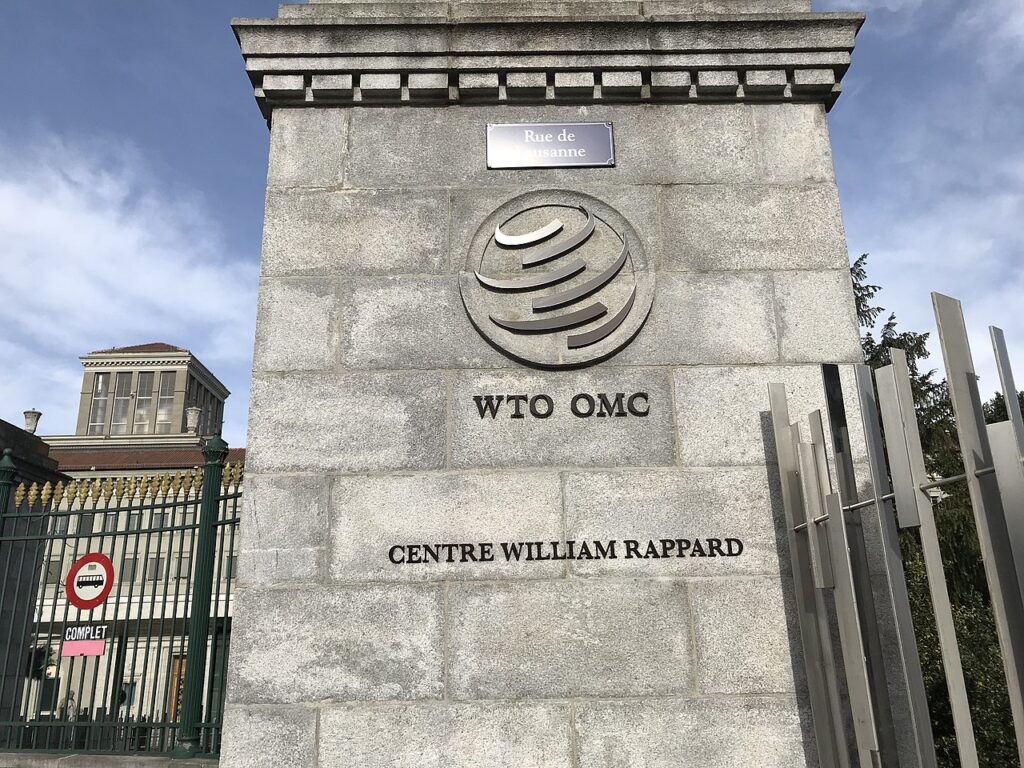
A home in Geneva
The WTO today is headquartered in the Centre William Rappard in Geneva, Switzerland. It has a staff of over 600.
They see their function as:
- Facilitating Trade negotiations
- Supporting the implementation and monitoring of agreements
- Settling disputes
- Building trade capacity in nations
- Promoting free trade and cooperation among nations
The organisation is fully paid for by the members and both its staff and leadership come from across the world. The seventh and current Director-General of the WTO is Ngozi Okonjo-Iweala, former Foreign Minister of Nigeria
The WTO’s website has a dedicated section explaining much more about themselves and their work. You can find it here.